Ram Setu — Turning Devotion into a Bridge-Building Puzzle
A name on every stone. A place for every piece. A bridge built together.
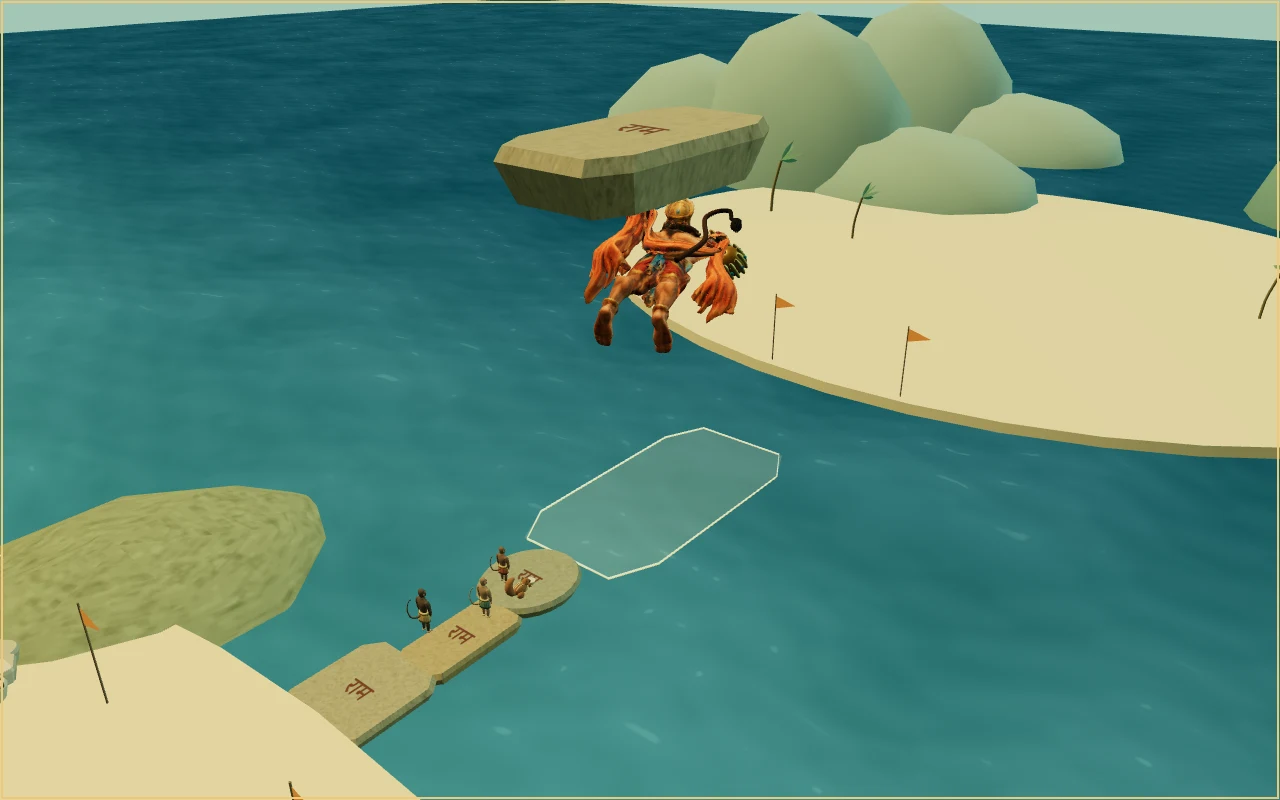
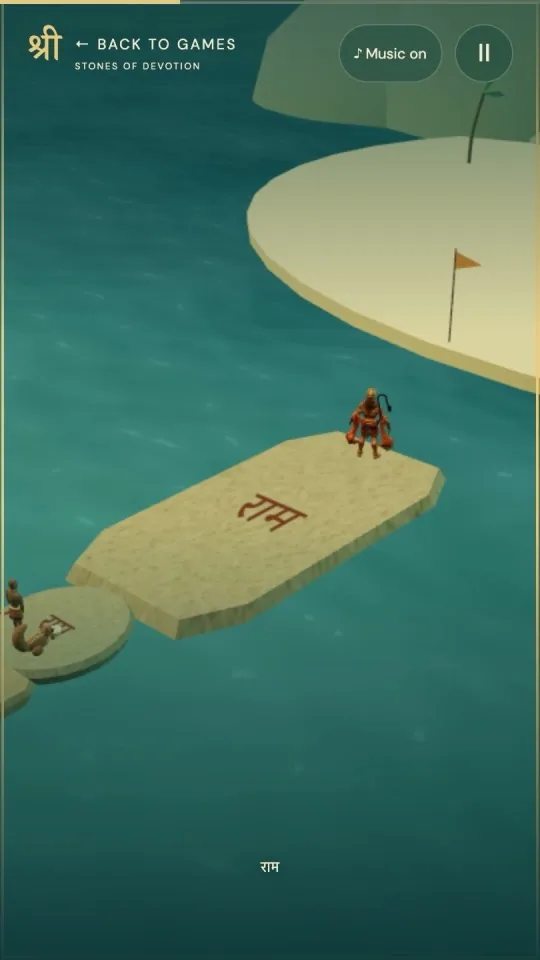
A worker writes राम on a stone. It splashes into the ocean, then rises to become part of a path. Later, Hanuman flies overhead carrying a boulder large enough to form a whole span. Near the end, a three-striped squirrel arrives with a tiny stone of her own.
These moments shape Ram Setu: Stones of Devotion, our new 3D browser game. After the flight of The Great Leap and the mountain carried in The Sanjeevani Rescue, we wanted players to build something together. The design question was simple: what makes placing the next stone an interesting decision?
Begin with the name
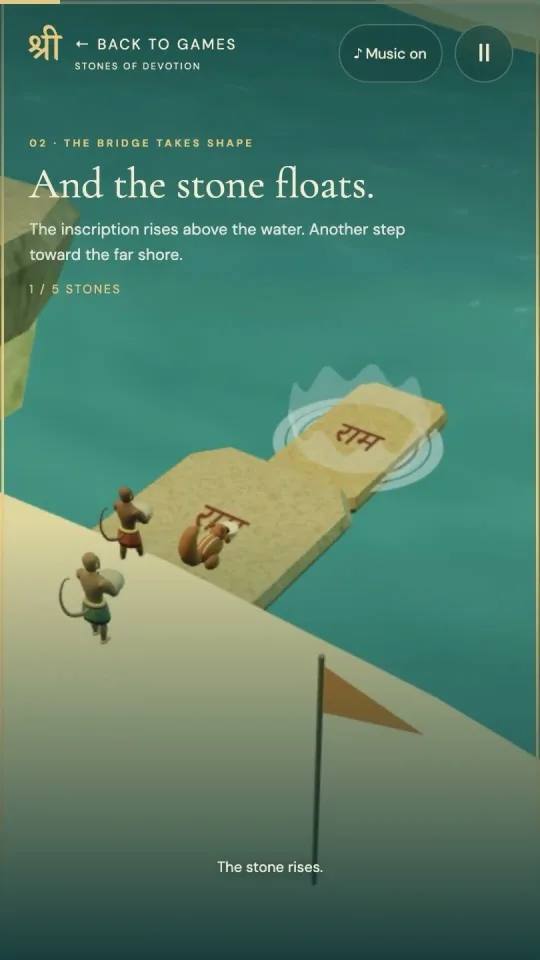
Every main stone begins with an inscription. Trace राम in Devanagari with your finger or mouse, or hold the writing button or Space for assistance. The writing appears on the stone itself and stays visible when it floats.
This gives construction a rhythm: write, place, watch the stone rise, then consider the next piece. Once a stone settles, the next one arrives automatically. There are five main placements, with Hanuman’s boulder between the first three and the final two. That keeps the journey short enough for each contribution to have its own moment.
How the bridge becomes a puzzler
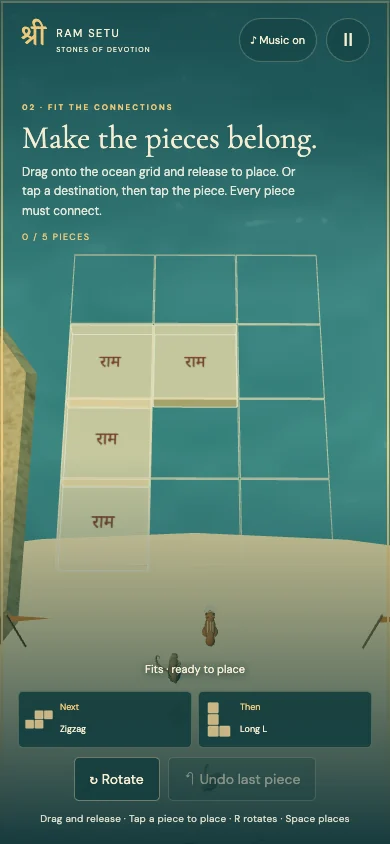
Sundara introduces the story with a simple path: tap the outlined opening in the ocean to place your stone. The harder levels widen that path into a grid. Now a stone can occupy several squares, forming an L, a domino, or a zigzag. These joined-square shapes are called polyominoes.
The fitting and rotation will feel familiar to players who enjoy Tetris-style puzzles. Here, the pieces wait for your decision, and completed rows remain in the bridge. There is no falling-piece countdown. Your challenge is to build a connected surface while leaving room for what comes next.
Three rules make each placement matter
- Stay inside the grid. Every square of the piece must fit within the outlined building area.
- Keep the spaces clear. A new stone cannot overlap one you have already placed.
- Make a connection. At least one square must reach the starting edge or share an edge with an existing stone. A diagonal touch is not enough.
A piece can satisfy all three rules and still leave an awkward gap for a later shape. That is where the puzzle lives. The next two pieces are visible, so you can think ahead: if this L goes across the near edge, will the next piece still have somewhere to go?
Place the stone where it belongs
The puzzle board sits directly on the ocean. Drag a piece into position and release, or tap a destination to preview it and tap the piece again to place it. You see its footprint over the actual space it will occupy.
Rotate turns the piece a quarter turn. Undo lets you revise placements within the current section if you have boxed yourself in. On a keyboard, use the arrow keys to move, R to rotate, U to undo, and Space to place. The aim is to make the spatial decision clear and give you room to reconsider it.
Three levels, more room to think
| Level | The challenge |
|---|---|
| Sundara | A guided single path. Learn the writing, floating stones, and story sequence. |
| Veera | Two columns. Turn L-shaped pieces and dominoes to fill each section. |
| Mahaveera | Three columns. Fit longer L shapes, a zigzag, and smaller L shapes while planning the remaining spaces. |
All three keep the same five main placements and the same story. Difficulty comes from the shapes and their arrangement. There is no timer or water drift to rush the decision. Finish Sundara and the ending offers Veera next; finish Veera and it offers Mahaveera. You can also replay or choose a level.
Hanuman changes the scale
After the first three stones, construction pauses for Hanuman. Inscribe the giant boulder, help him grow and gather strength, then watch him lift it and fly out over the sea. Tap the outlined span to release it. The boulder splashes down, dips beneath the surface, and rises into a broad section of the bridge.
This moment gives the journey a change of scale between its two smaller puzzles. The span becomes part of the route, ready for the last two pieces to extend it toward the far shore.
The smallest stone has a real place
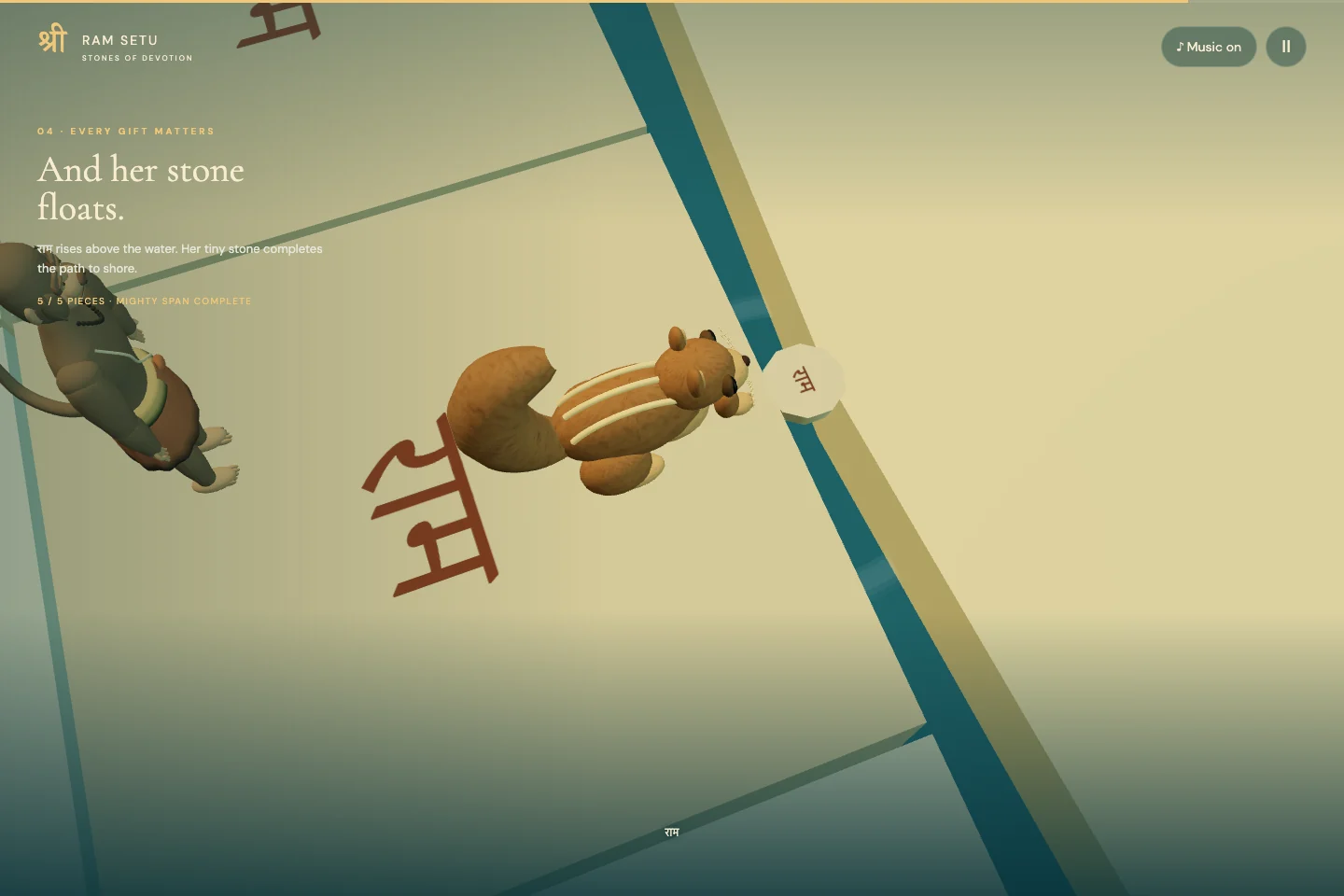
Our homage to Rama’s squirrel comes at the end. She walks along the bridge to its forward edge, with three stripes visible on her back. Her tiny stone receives the same राम inscription as the larger ones.
She drops it into the ocean at the final narrow seam. It dips, floats back up, and closes the connection to shore. Giving her offering a useful place was central to the scene: when the party crosses, the route includes what she brought.
A new chapter in our playable stories
Ram Setu brings forward our Hanuman character from the earlier games, with original bridge scenery, workers, stone shapes, and squirrel animation. Rama and Lakshmana have new Blender models inspired by our Sanjeevani illustrations. The Hanuman Chalisa recording accompanies the journey, with music controls during play and listening links at the end.
We present this as a Ram Setu story adaptation in our collection. Its inscription interactions, shaped-piece boards, giant span, and final pebble connection are choices we made for the game; we do not attach them to a specific Chalisa or Bhimarupi verse.
Once the last stone floats, hold Walk or Space to accompany the party across. The path beneath them is the one you have just put together, piece by piece.
Watch the bridge grow
Two moments from the build — inscribing the name, and the mighty stone’s splashdown.
-
Can you build the Setu?24 seconds · YouTube Short
-
Will Hanuman’s giant boulder float?12 seconds · YouTube Short
Begin with a name. Find a place for every stone.
Play Ram Setu →